Every injection molding project begins with the expectation of perfect dimensions, flawless cosmetics, and a predictable cycle time. However, the reality on the production floor is often drastically different. Unexplained warpage, frustrating sink marks, and dimensional variations between batches frequently plague manufacturing runs. The root cause of these costly defects almost always traces back to one critical variable: thermal instability. When thermal management fails, scrap rates skyrocket, delivery schedules slip, and the overall cost per part increases. Overcoming these manufacturing hurdles requires a deep understanding of thermodynamics and process engineering. Implementing strict injection molding temperature control is the only definitive way to eliminate these variables.
By mastering the thermal dynamics within the tooling and the machine barrel, manufacturers can transform an unpredictable process into a highly repeatable science. Whether producing simple consumer goods or complex custom plastic injection molding parts for critical applications, thermal precision is the foundation of quality assurance.
The Fundamentals of Mold Temperature Control
To solve complex defects, engineers must first understand the fundamental differences between the heat generated by the machine and the heat extracted by the tool. Implementing robust mold temperature control injection molding strategies requires balancing these opposing forces to achieve thermal equilibrium.
Melt Temperature vs. Mold Temperature
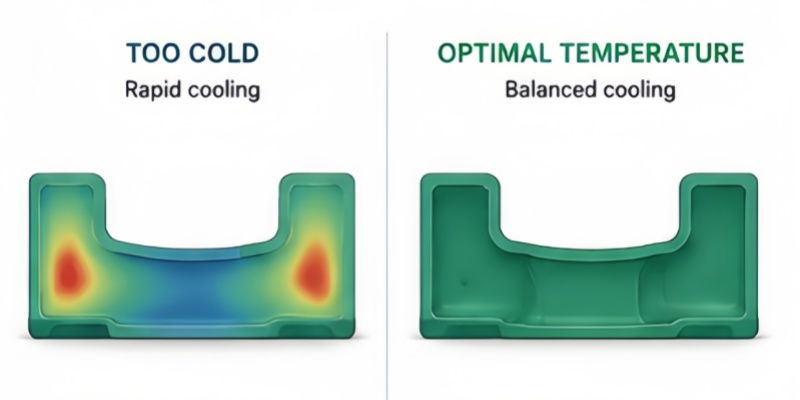
The foundation of any robust process begins with understanding the importance of melt temperature in injection molding. Melt temperature refers to the actual thermal state of the polymer as it is injected into the cavity. It is primarily driven by the mechanical shear of the screw. In contrast, mold temperature is the surface temperature of the steel cavity, which dictates how quickly that molten polymer solidifies. If the tool is too cold, the plastic freezes prematurely, causing high internal stress and poor weld lines. If it is too hot, the cycle time extends unnecessarily.
How Temperature Affects Part Consistency
Understanding how mold temperature affects plastic parts is crucial for troubleshooting. When hot plastic contacts the tool steel, a temperature gradient forms. For semi-crystalline materials, a higher steel temperature allows for a higher degree of crystallinity, leading to improved mechanical strength and chemical resistance. Conversely, for amorphous polymers, cooling too rapidly traps stress within the polymer chains. When the part is ejected and exposed to room temperature, this trapped stress releases, resulting in severe dimensional distortion.
Symmetry in Heat Transfer
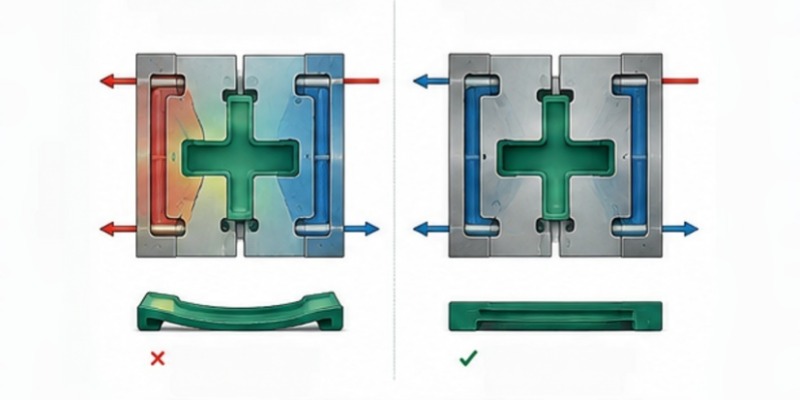
A common oversight in injection mold manufacturing is ignoring thermal symmetry. The core and cavity halves of a tool often have different masses and geometries. The core typically retains more heat because it is surrounded by the hot polymer, while the cavity dissipates heat outward. If engineers do not design the cooling system to extract heat symmetrically, the plastic part will shrink unevenly. This differential shrinkage rate is the primary mechanism behind warpage.
Mastering Barrel Temperature Control
While the tool handles the cooling, the injection unit is responsible for melting the resin uniformly. Precise injection molding machine barrel temperature control is what prevents un-melted pellets or degraded resin from entering the cavity.
Understanding the Four Barrel Zones
Learning how to control barrel temperatures in injection molding requires dissecting the plasticating unit into distinct functional zones.
-
Feed Zone: The rear section where solid pellets enter. Temperatures here are kept relatively low to prevent the resin from melting prematurely and bridging on the screw.
-
Compression Zone: The transition area where the root diameter of the screw increases. This is where primary melting occurs, largely driven by mechanical compression.
-
Metering Zone: The forward section that homogenizes the melt, ensuring a uniform viscosity before it reaches the front of the barrel.
-
Nozzle Zone: The final exit point. The temperature here must prevent drool while ensuring the gate does not freeze off prematurely.
Choosing the Right Temperature Profile
Selecting the correct thermal profile is non-negotiable for injection molding temperature controls. The Standard Ramp profile gradually increases heat from the feed zone to the nozzle, ideal for stable materials like ABS. The Flat Profile maintains identical setpoints across the compression and metering zones, often used for engineering resins like Polycarbonate. The Reverse Profile runs hotter in the feed zone and cooler towards the nozzle; this is frequently utilized for heat-sensitive materials to prevent degradation during the residence time. Using the correct injection molding temperature control for polycarbonate/PET versus nylon makes a massive difference in melt quality.
Why Barrel Setpoints Don’t Always Match Melt Temperature
Processors often experience false confidence when looking at the machine display. The heater bands provide external heat, but up to 80% of the energy required to melt the plastic comes from shear heating—the friction generated by the screw turning against the pellets. This means that even with perfect display readings, the actual melt temperature can be significantly higher. Identifying the causes of temperature fluctuation in injection molding often requires measuring the actual polymer purge with a handheld pyrometer rather than trusting the machine’s thermocouples.
Choosing the Right Temperature Control Equipment
Achieving thermal stability is impossible without the right auxiliary equipment. Selecting an appropriate temperature control unit for injection molding (TCU) dictates how effectively you can extract heat from the steel.
Water vs. Oil: Which is Better?
When comparing a mold temperature controller water vs oil, the choice depends entirely on the required operating range. Water-based units offer superior thermal conductivity and heat transfer efficiency, making them the standard choice for most applications up to 120°C (or 160°C for pressurized water systems). However, for high-temperature engineering polymers like PEEK or Ultem, an oil-based injection mold temperature controller is mandatory, as oil can safely reach temperatures exceeding 300°C without extreme pressure buildup.
Evaluating the Equipment Components
A high-quality temperature controller injection molding machine relies on three main components: the heater tank, the pump, and the microprocessor. If a buyer is conducting a cost comparison of standard vs precision injection molding temperature control equipment, they must look at the pump curves. A cheap unit may have a heater capable of reaching the setpoint, but an undersized pump will fail to push adequate turbulent flow through narrow cooling channels.
Pump Sizing and Flow Rate Calculations
Relying on pressure alone is a mistake; flow rate is what actually removes heat. Performing a precise mold temperature controller pump sizing calculation ensures that the water achieves turbulent flow inside the channels (a Reynolds number above 4000). Turbulent flow breaks the thermal boundary layer against the steel wall, exponentially increasing the heat transfer coefficient.
Advanced Techniques in Mold Thermal Management
The most sophisticated TCU in the world cannot compensate for poorly designed steel. Advanced injection mold temperature control begins in the engineering department before the tool is ever cut.
Designing Cooling Channels for Uniform Temperature
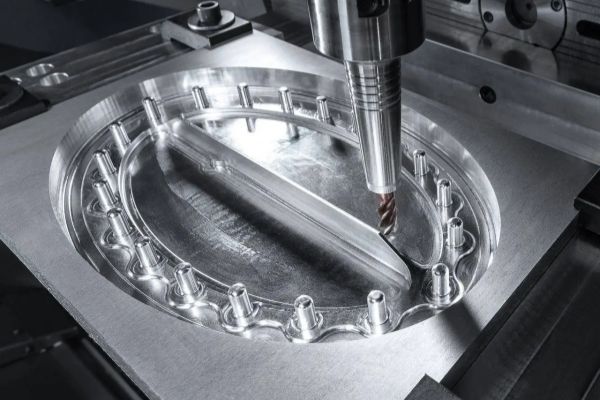
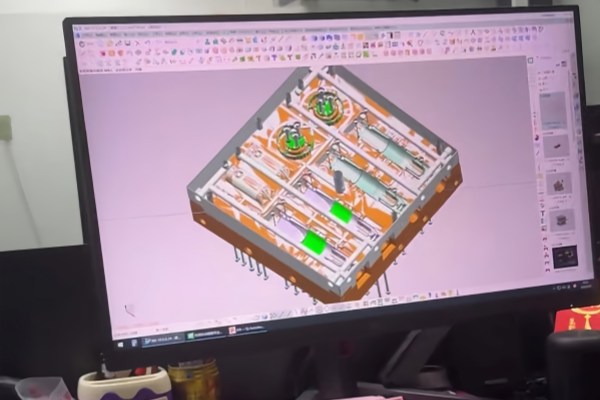
Effective injection molding cooling system design requires placing cooling lines as close to the cavity surface as the steel’s structural integrity allows. For complex geometries, straight-line drilling is insufficient. Engineers utilize baffles and bubblers to force cooling water up into deep cores and ribs. Furthermore, when designing a multi-cavity injection mold, the cooling layout must be perfectly balanced so that the flow rate and water temperature are identical for cavity number one and cavity number thirty-two.
Mitigating Warpage Through Differential Cooling
When thermal symmetry cannot be achieved geometrically, engineers actively use differential cooling. Reducing warpage through precise mold temperature control involves intentionally setting the core temperature higher or lower than the cavity temperature. By manipulating the cooling rates on opposite sides of the part wall, processors can physically pull the plastic in a specific direction during shrinkage, counteracting the natural tendency to warp.
The Financial Impact of Conformal Cooling
Traditional straight drilled channels struggle to follow the contours of complex precision injection molds. This is where 3D-printed steel inserts come into play. Understanding how conformal cooling improves injection molding temperature control ROI is a game-changer for B2B buyers. Because the cooling channels wrap exactly around the part’s geometry at a uniform distance, hot spots are eliminated. This not only drastically reduces scrap but can shave 20% to 40% off the cycle time, vastly improving the output yield for any high-volume multi-cavity injection molding project.
Recommended Settings for Thermal Control
To establish a baseline, process engineers rely on established material data. The table below outlines general starting points, though fine-tuning is always required based on specific part geometry and wall thickness.
| Resin Material | Typical Melt Temperature (°C) | Target Mold Temperature (°C) | Recommended Barrel Profile |
| ABS | 210 – 240 | 40 – 80 | Standard Ramp |
| Polycarbonate (PC) | 280 – 320 | 70 – 120 | Flat or Flat-Ramp |
| Polypropylene (PP) | 220 – 260 | 20 – 60 | Standard Ramp |
| PA66 (Nylon) | 270 – 300 | 60 – 90 | Reverse or Flat |
Troubleshooting Common Thermal Issues
Even with excellent design, production environments introduce variables. Knowing how to react to alarms and defects separates average operators from master technicians.
Resolving Equipment Errors
Troubleshooting injection molding temperature controller errors usually starts with flow restrictions. Scale buildup from hard water acts as a massive thermal insulator inside the tool. Knowing how to clean injection molding cooling channels safely using chemical descalers is a mandatory maintenance procedure. Without regular flushing, the flow rate drops, turbulent flow turns into laminar flow, and the tool inevitably runs hot, regardless of the TCU setpoint.
Fine-Tuning PID Parameters
To maintain pinpoint accuracy, understanding the best PID settings for mold temperature controller units is vital. The Proportional band determines the heating power applied; the Integral corrects historical deviations; the Derivative predicts future changes based on the current rate of temperature fluctuation. Improperly tuned PID loops lead to temperature overshoot, where the heater stays on too long, causing the actual tool temperature to oscillate wildly around the target setpoint.
Partner with a Reliable Injection Molding Manufacturer Like Rally Plastic
Achieving perfect injection molding temperature control is not a matter of luck; it requires advanced engineering, rigorous scientific molding principles, and state-of-the-art equipment. When a project faces tight tolerances and demanding cosmetic requirements, having a partner who understands the deep physics of polymer behavior is the only way to ensure commercial success.
At Rally Plastic, we specialize in overcoming the industry’s toughest thermal management challenges. Our engineering team leverages comprehensive mold flow analysis, optimized cooling architectures, and high-precision equipment to guarantee your parts are molded perfectly from the first shot to the millionth. Whether you need standard production or highly complex custom plastic injection molding, we deliver the consistency and quality your supply chain demands. Contact Rally Plastic today!

Frequently Asked Questions (FAQs)
Why does my mold temperature controller keep alarming at high pressure?
If your unit continuously triggers a high-pressure alarm, it usually indicates a severe blockage in the cooling circuits. Calcium buildup, rust, or debris can restrict water flow, causing pump pressure to spike rapidly. To resolve this, flush the mold’s channels with a professional descaling solution, inspect all quick-disconnect fittings, and ensure the hoses are not kinked. Regular preventative maintenance prevents these flow restrictions and ensures stable heat transfer.
What is the best PID setting for a mold temperature controller?
The ideal PID (Proportional, Integral, Derivative) settings depend heavily on your specific equipment and the mold’s physical mass. Start by using the manufacturer’s auto-tune feature to establish a baseline. If the temperature overshoots significantly, increase the derivative value or widen the proportional band. Proper PID tuning prevents temperature oscillation, ensuring that steady thermal conditions are maintained throughout the entire injection cycle without dramatic spikes or drops.
Can the mold temperature be set too high?
Yes, operating with a tool temperature that is too high causes multiple manufacturing inefficiencies. While hotter steel improves plastic flow and surface gloss, it significantly extends the cooling phase, increasing overall cycle time and reducing production output. Furthermore, excessive heat can lead to material degradation, flash, or parts physically sticking to the cavity walls. Always strictly follow the resin manufacturer’s data sheet to balance aesthetics with efficiency.
How does mold temperature affect cycle time?
Mold surface temperature has a direct and massive impact on cycle time. The cooling phase often accounts for over 50% to 70% of the entire manufacturing cycle. If the tool runs hotter, the polymer takes longer to solidify to a temperature where it can be safely ejected without physical deformation. Lowering the setpoint speeds up the process but might cause premature freezing, so balance is essential for optimal ROI.
Why doesn’t the barrel temperature match the actual melt temperature?
The barrel setpoints only control the external heater bands. However, the actual melt temperature is largely generated by internal shear friction as the screw rotates and compresses the solid plastic pellets. If screw RPM or back pressure is too high, this shear heating can cause the internal melt to exceed the barrel’s programmed setpoints. Processors should always verify the actual polymer temperature using a handheld pyrometer.
Does poor injection molding temperature control cause warpage?
Absolutely. Uneven thermal conditions between the core and cavity halves are a primary driver of warpage. When one side of the part cools faster than the other, the differential shrinkage rates induce severe internal stress, causing the part to bow or twist upon ejection. Maintaining injection molding temperature control and thermal symmetry across the entire tool keeps shrinkage consistent, ensuring the final component remains dimensionally accurate.
How often should I clean the injection mold cooling channels?
Cooling circuits should be inspected and flushed as part of a routine preventative maintenance schedule, typically every three to six months. The exact frequency depends on your facility’s water quality. Hard water accelerates mineral scale buildup, which drastically reduces thermal conductivity and restricts flow. Implementing a closed-loop water treatment system can extend the time between cleanings, protecting your tooling investment and maintaining consistent process conditions.
Key Terminology Glossary
-
Thermocouple: A highly sensitive industrial sensor used to measure temperature accurately. In molding machines and TCUs, it provides the real-time thermal data required for the microprocessor to adjust heating or cooling outputs.
-
Shear Heating: The internal heat generated within the plastic resin caused by friction. As the machine’s screw rotates, the mechanical energy of compressing and shearing the plastic pellets is converted into thermal energy, responsible for the majority of the melting process.
-
Conformal Cooling: An advanced tooling technology where cooling channels are 3D-printed (typically using Direct Metal Laser Sintering) to perfectly follow the complex geometric contours of the part, ensuring uniform heat extraction that traditional straight-drilled channels cannot achieve.