
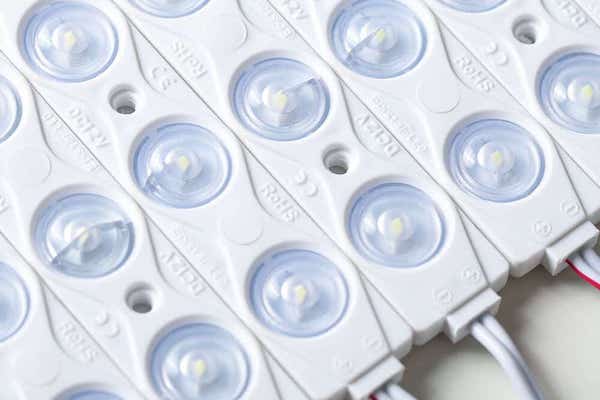
Manufacturers of LED lighting components often struggle with high production costs, inconsistent quality, and limited material flexibility. These challenges intensify as consumer demand grows and product designs become more complex. Fortunately, injection molding offers a scalable, cost-effective, and highly precise solution. This article explores why injection molding is the ideal manufacturing process for LED lighting parts.
Injection molding is ideal for LED lighting components due to its unmatched precision, repeatability, and material versatility. It enables complex geometries, excellent optical clarity, and robust thermal resistance—critical for LED housings, lenses, and diffusers. This process reduces per-unit costs for high volumes while maintaining tight tolerances.
Overview of LED Lighting Components
LED lighting assemblies consist of multiple interdependent plastic parts, each designed to optimize light performance, thermal management, and mechanical stability. Common injection molded components include lenses, diffusers, housings, mounting clips, and reflectors.
Lenses and diffusers control light dispersion and clarity, requiring high optical quality materials like PC or PMMA. Housings and reflectors must withstand prolonged heat exposure from high-power LEDs, often demanding materials with good thermal resistance and flame retardancy. Mounting clips and enclosures must deliver secure mechanical support while remaining lightweight.
Traditionally, many of these components were made from glass or metal, which are heavier and more costly to shape into complex geometries. With advanced plastic resins, manufacturers now achieve better durability, reduced weight, and simplified production. As a result, plastics have replaced conventional materials in most modern LED systems—without sacrificing performance.
Why Injection Molding Works for LED Parts
Injection molding offers unmatched precision and repeatability, making it ideal for LED lighting parts that demand tight tolerances and consistent optical performance. This process enables the creation of complex shapes with fine details, ensuring uniform light diffusion and component fit.
High-volume production benefits the most. Once the mold is finalized, each part produced is identical—critical for applications where even slight dimensional variance can affect performance or appearance. Whether you’re producing 10,000 diffusers or 50,000 housings, consistency remains constant.
Another key advantage is weight reduction. Compared to metal or glass parts, injection molded plastics significantly reduce component weight, which is especially beneficial for ceiling-mounted or portable LED systems. This simplifies installation and transportation without compromising durability.
Furthermore, design integration is easier with plastic molding. Features like clips, screw bosses, and cable channels can be built directly into the part, eliminating the need for secondary assembly steps and reducing labor costs.
In short, injection molding streamlines LED component production with accuracy, repeatability, and efficiency—qualities essential for today’s lighting products.
Material Selection for LED Injection Molding
Choosing the right plastic is crucial in achieving performance, safety, and longevity in LED lighting components. Each material offers specific benefits based on the application—whether it’s optical clarity, heat resistance, or mechanical strength.
PC (Polycarbonate) is widely used for lenses and covers due to its excellent optical clarity, impact resistance, and high heat tolerance. For parts requiring maximum transparency, PMMA (Acrylic) is ideal, though it offers lower impact strength than PC.
PBT (Polybutylene Terephthalate) is suited for housings and connectors because of its superior electrical insulation, heat resistance, and chemical stability. Nylon (PA) is used in structural components that demand high mechanical strength and moderate thermal performance.
These materials also provide varying degrees of UV stability, an important factor for outdoor or high-lumen applications. Selecting the proper resin ensures optimal function and longevity under continuous LED heat and light exposure.
| Material | Optical Clarity | Heat Resistance | UV Stability | Impact Strength | Common Use |
|---|---|---|---|---|---|
| PC | ★★★★☆ | ★★★★☆ | ★★★☆☆ | ★★★★★ | Lenses, light covers |
| PMMA | ★★★★★ | ★★★☆☆ | ★★★★☆ | ★★☆☆☆ | Diffusers, light panels |
| PBT | ☆☆☆☆☆ | ★★★★☆ | ★★★☆☆ | ★★★☆☆ | Housings, connectors |
| Nylon (PA) | ☆☆☆☆☆ | ★★★☆☆ | ★★★☆☆ | ★★★★☆ | Clips, brackets, mounts |
Material choice determines light transmission, heat tolerance, and product durability—all vital in LED component design.
Optical Clarity and Surface Finish
Optical clarity and surface quality directly impact the performance of LED lighting components. A smooth, polished finish ensures maximum light transmission and uniform diffusion, especially in lenses and diffusers. When surfaces are uneven or hazy, light scattering and distortion occur, reducing brightness and efficiency.
Injection molding enables high-quality surface finishes straight from the mold, eliminating the need for additional polishing or secondary operations. This is particularly valuable in high-volume production, where cost and consistency matter.
PC (Polycarbonate) and PMMA (Acrylic) are the most commonly used materials for clear parts due to their transparency and ability to hold fine surface details. These materials, when molded correctly, can achieve a glass-like appearance—ideal for high-end LED applications requiring crystal-clear lenses or light guides.
Ultimately, a precise mold design and proper material selection lead to better optical performance and a visually superior LED product.
Heat Resistance and Electrical Insulation
LED components must endure continuous heat during operation, especially in high-power lighting systems. Injection-molded engineering plastics such as PC, PBT, and Nylon offer excellent thermal stability, withstanding temperatures ranging from 130°C to 150°C without deformation or discoloration.
In addition to heat resistance, these materials provide superior electrical insulation, which is critical for safety. LED drivers, connectors, and housings must prevent electrical leakage and short circuits, especially in compact assemblies.
Injection molding allows precise material control, ensuring uniform wall thickness and avoiding hotspots that could compromise insulation performance. This makes the process ideal for fabricating parts with complex shapes and thin walls without sacrificing thermal and electrical integrity.
For high-output or industrial-grade LEDs, heat management and electrical safety are non-negotiable. Injection-molded plastic components meet both requirements efficiently, enabling reliable and long-lasting LED operation.
Design Flexibility for Custom Parts
Injection molding provides exceptional design flexibility, enabling engineers to integrate multiple features—such as clips, tabs, lenses, and cable guides—into a single molded part. This not only reduces the total number of components but also streamlines assembly and improves structural integrity.
Unlike metal or glass fabrication, plastic injection molding supports thinner walls, sharper corners, and complex geometries without compromising strength. This capability is particularly valuable for compact LED systems that demand precise optical alignment and internal space efficiency.
By combining multiple functions into one part, manufacturers can eliminate secondary assembly steps, reduce tooling and labor costs, and shorten production lead time. This is especially advantageous for high-volume runs and custom designs with detailed requirements.
In LED lighting, where aesthetics, thermal control, and electrical safety must coexist, custom-molded plastic parts deliver both functionality and visual appeal—all in a single manufacturing process.
Cost Efficiency in Mass Production
Injection molding is one of the most cost-effective methods for large-scale LED component manufacturing. Once the mold is created, the process becomes highly efficient, with low cycle times and high repeatability. Parts can be produced in seconds, making it ideal for high-volume production.
The process is also automation-ready. Robotic part removal, mold cooling systems, and automatic material feeding greatly reduce manual intervention, which in turn lowers labor costs and increases output consistency. Combined with multi-cavity molds, manufacturers can produce multiple LED components per cycle, further enhancing productivity.
Material waste is minimal compared to subtractive processes like CNC machining. Thermoplastics can be precisely dosed, and regrind materials can often be reused. This contributes to both cost savings and sustainability.
For LED manufacturers, especially those producing lenses, housings, and clips at scale, injection molding offers unmatched cost efficiency. It supports fast lead times, consistent quality, and competitive unit pricing—critical factors in today’s lighting market.
Case Example – Plastic Diffusers for Commercial LEDs
A major commercial lighting brand partnered with our team for custom injection molding of plastic LED diffusers. The goal was to produce high-transparency parts with consistent optical performance, tight dimensional tolerances, and cost efficiency for large-scale retail lighting systems.
The product required a PMMA-based diffuser with excellent light diffusion properties while maintaining 92%+ light transmission. Mold design incorporated multi-point gate locations to prevent flow marks and achieve uniform surface finish. We maintained a tolerance of ±0.05mm to ensure compatibility with the aluminum housing and LED PCB.
The injection molding process allowed for rapid cycle times, reducing unit cost and enabling weekly production of over 30,000 units. The client benefited from shorter assembly time due to integrated mounting features, and significantly reduced post-processing needs.
This case demonstrates how LED diffuser production via injection molding can meet strict requirements for clarity, strength, and efficiency—making it the preferred method in commercial lighting systems.
Key Considerations When Choosing a Supplier
Selecting the right injection molding partner for LED parts requires more than just price comparison. Look for a manufacturer with ISO 9001 certification and experience in optical molding, especially with materials like PC and PMMA.
Transparent communication is essential—suppliers should guide you through material selection, mold design, and process optimization. Ensure they offer clear updates on lead times, tooling progress, and quality control.
Also, choose a supplier that provides end-to-end support, from rapid prototyping to full-scale production. This shortens development cycles and minimizes the risk of costly revisions.
Ultimately, a qualified supplier helps you achieve both performance and efficiency in your LED lighting products—while maintaining strict compliance with quality standards.
Conclusion
Injection molding combines precision, speed, and scalability, making it the ideal solution for producing high-performance LED lighting components. From lenses and diffusers to housings and clips, this process supports complex designs, reduces production costs, and ensures consistent quality—critical factors in today’s competitive lighting industry.
Ready to take your LED components to the next level?
Upload your drawings and request a quote today.
Contact RALLY Plastic for custom, high-precision plastic parts tailored to your project needs.